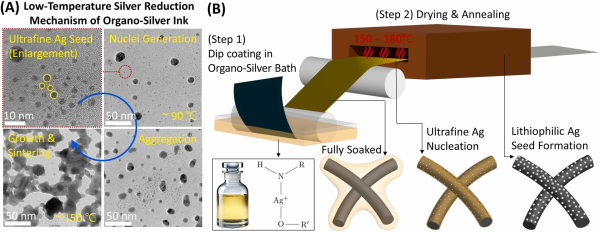
Three-dimensional (3D) porous hosts decorated with uniformly distributed lithiophilic nanoseeds are an effective route to fabricate highly stable Li metal anodes, yet most nanoseeding methods require high temperatures or complex chemistries that impede manufacturing scalability. Here, we report a facile, industry-compatible strategy that generates conformal Ag nanoseeds (≈ 20–50 nm) on electrospun carbon nanofiber (CNF) scaffolds by thermally decomposing a commercial organo-silver ink at only 150–180 °C. This low-temperature treatment preserves the CNF architecture while providing an ultrahigh density of metallic Ag0 nuclei that lower the Li nucleation barrier. Relative to bare CNF, the Ag-decorated host (CNF@Ag) reduces the initial nucleation overpotential from 22 mV to 7 mV (≈ 66 % decrease) and doubles the exchange current density (0.58 → 1.2 mA cm⁻2). Consequently, CNF@Ag exhibits significantly higher long-term stability than the bare CNF, as confirmed by galvanostatic cycling in both symmetric and half-cell configurations. In practical full-cell tests, CNF@Ag anodes deliver over 300 stable cycles at 0.5 C and exhibit substantially lower polarization up to 10 C when coupled with LiFePO4 cathodes. Spectroscopic (XPS, Raman) and microscopic (SEM/TEM) analyses confirm that the process is chemically benign, yields uniformly anchored seeds without damaging the carbon framework, and effectively stabilizes the Li plating/stripping morphology. This organo-metallic ink-based approach thus offers a generalizable, low-temperature pathway to integrate lithiophilic nanoseeds into 3D electrodes, advancing the development of high-energy, fast-charging lithium-metal batteries.