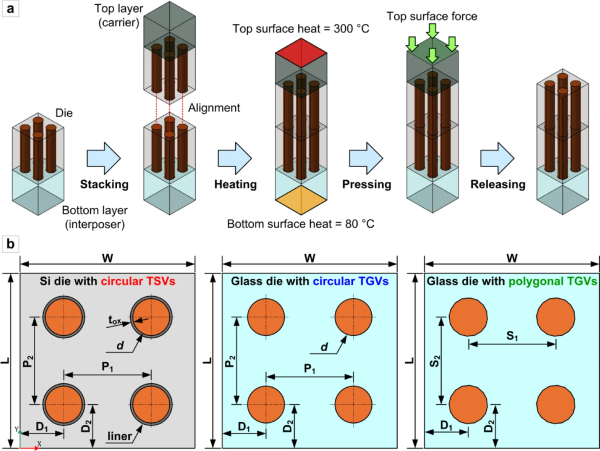
A thermally and structurally robust design of the through-glass via (TGV) array is presented for reliable Cu–Cu hybrid bonding applicable to three-dimensional (3D) multilayer semiconductor packaging. Through rational heat transfer modeling and variation of the via materials (Si and glass), section shapes (circle and polygon), and arrays (2 × 2, 3 × 3, and 4 × 4), the thermal conduction and stress behavior of hybrid Cu-Cu bonding structures are systematically analyzed based on the finite element method (FEM), multi-objective genetic algorithms (MOGA), and machine learning. While the MOGA can efficiently minimize the thermo-mechanical stress and deformation beyond the baseline FEM-based design, the random forest model trained on Pareto-optimal solutions successfully validates and refines the MOGA-level design result with significantly reduced computational cost. The TGVs outperforms the through-silicon vias (TSVs) with more effective mitigation of mismatch in thermal expansion. For supporting the laser ablation-assisted fabrication feasibility, a 15-sided polygonal TGV structure is introduced and compared with the circular via structures, which exhibit improved thermo-mechanical stability. The proposed machine learning model can rapidly and precisely predict multiple indicators, in this case temperature, deformation, and stress, with significantly reduced computing resource and time (~ 4 s compared to FEM (144 s) and MOGA (300 s)), making it readily expandable to scalable arrays and stacking numbers. This work provides a practical and versatile framework for the design and fabrication of robust TGV structures for diverse 3D semiconductor chip packages including high-bandwidth memory devices requiring stacking of ten or more layers with high thermo-mechanical reliability.